Mercy for the Makeover
From the Mess to the Makeover
After God reveals to us what has been hidden in our hearts and under our hurt, and after God cleanses the wounds we’ve carried, our experience with the King often awakens an urgency within us to desire transformation. We want to see evidence that we are no longer bound by our past failures and faults - that the future will not be a fragmented version of who we were, but a fresh start toward who we were created to be.
Before we reach for self-improvement classes or visit the self-help section of our local bookstores, we must pause and consider that God offers us something much deeper than the lonely road to leveling up by offering us mercy and grace that receives us even before restoration begins. The same mercy that met us in our mess now meets us at the door, interrupting our plans to fix ourselves and reminding us that healing can begin simply by being embraced.

I don’t know about you, but I love a good makeover. From the outside, a makeover feels and looks powerful.
We can change our hair, replace our wardrobes, reshape our physique, and sometimes even nip and tuck the parts of our bodies that we don’t like.
What is it about a makeover that seems to promise renewal, hope, and life-changing transformation?
Is it evidence that we have control over our chaos and distance from the devastation of our past?
Maybe it suggests that if we look different, we will act differently and perform differently.
Then, finally, the pain behind us will lose its power, the shame of our present will release us, and the fresh start we’ve been longing for will come and validate our worth.
But…
What happens when we take that same perspective from a natural makeover and come to God with a plan to look better, a promise to do better, and a prepared explanation of how we’ll earn our place again?
What we often miss is that our attempts to make ourselves over and earn God’s forgiveness and love blind us to the grace and mercy that meet us at the moment we repent and return to Him.
Unlike physical makeovers, spiritual transformation doesn’t rely on external fixes; it starts with mercy that restores relationships.
In the story we have come to know as “The Prodigal Son”, we see that mercy is not passive kindness but active compassion that moves toward the undeserving. After a series of reckless decisions and riotous living, the son prepares a makeover plan of his own: to go from son to servant.
Luke 15:11-19 (KJV)
11 And he said, A certain man had two sons:
12 And the younger of them said to his father, Father, give me the portion of goods that falleth to me. And he divided unto them his living.
13 And not many days after the younger son gathered all together, and took his journey into a far country, and there wasted his substance with riotous living.
Sometimes the longest part of the journey home is coming to yourself.
14 And when he had spent all, there arose a mighty famine in that land; and he began to be in want.
15 And he went and joined himself to a citizen of that country; and he sent him into his fields to feed swine.
16 And he would fain have filled his belly with the husks that the swine did eat: and no man gave unto him.
17 And when he came to himself, he said, How many hired servants of my father's have bread enough and to spare, and I perish with hunger!
18 I will arise and go to my father, and will say unto him, Father, I have sinned against heaven, and before thee,
19 And am no more worthy to be called thy son: make me as one of thy hired servants.
By asking for his inheritance early, the son had essentially declared his father dead to him. Instead of prioritizing his relationship with his father and embracing his position as a son, he emphasized what his father could give him.
When he returns, he is not oblivious to the deep shame his actions and decisions have placed on his father and family. Though not legally condemned to death, the son’s choices placed him in a position of total disgrace marked by exclusion and loss of identity.
He returns home carrying the weight of shame, exclusion, and social death, fully risking rejection. He comes with a request to be a servant instead of a son. Yet, the father meets him with mercy, restoring his identity before the son can even finish his confession.
Luke 15:20-24 (KJV)
His father sees him from afar, and instead of meeting him with accusations or public rejection, the father runs to meet him and calls for a robe, a ring, and sandals to restore him.
20 And he arose, and came to his father. But when he was yet a great way off, his father saw him, and had compassion, and ran, and fell on his neck, and kissed him.
21 And the son said unto him, Father, I have sinned against heaven, and in thy sight, and am no more worthy to be called thy son.
22 But the father said to his servants, Bring forth the best robe, and put it on him; and put a ring on his hand, and shoes on his feet:
23 And bring hither the fatted calf, and kill it; and let us eat, and be merry:
24 For this my son was dead, and is alive again; he was lost, and is found. And they began to be merry.
This moment is far more powerful than we often realize, because this is a society where patriarchs do not run as it was considered highly undignified and socially unacceptable.
But…
Before the village ever has an opportunity to respond to the son, the father runs, identifying with the son’s undignified state, absorbing the son’s shame onto himself, and preventing community rejection.
He then gives him a robe to signal restored honor and to cover his shame, a ring to signify authority, and sandals to signify restored sonship.
Even though the son has rehearsed self-punishment and expects discipline from the father, the father rejects the son’s request to be a servant and restores him fully to his position as a son. Once unclean and exiled, deserving of the loss of family identity and inheritance, the son receives acceptance and belonging from the father before his actions can prove whether his remorse is temporary or his repentance complete.
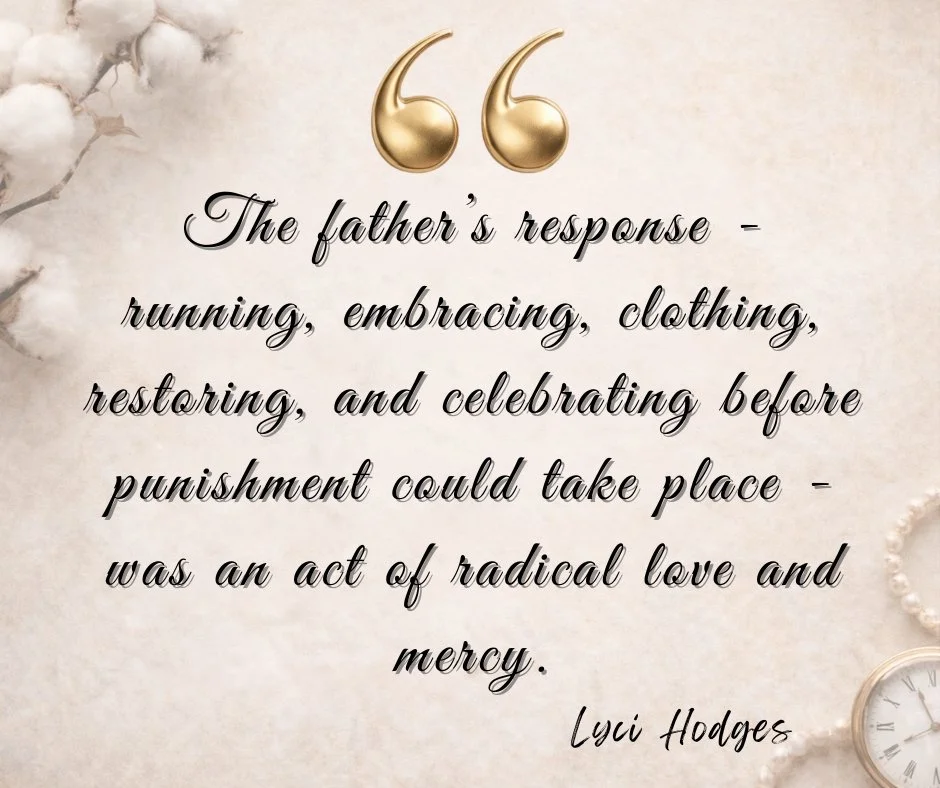
We often think that mercy excuses behaviors that will never change and delays growth by enabling weakness. Instead, God’s mercy and grace restore our position and leave the decision to change our patterns in our hands. Through God’s intimate and protective love, we are not treated with distant tolerance, but invited back into relationship, where transformation is possible.
If you are struggling with how to fully return to our Heavenly Father after realizing the mess and mistakes you have made, please know that you are not alone. I want to encourage you: you don’t have to fix yourself or be perfect to come home. Your makeover will follow your acceptance of God’s love, grace, and mercy.
There is mercy for the makeover… and it begins the moment you return to the Father.
Dear Lord,
We come to You today admitting that we have made messes and mistakes and are in desperate need of Your mercy… and a makeover. We could come to You with plans to fix ourselves, to explain, improve, and try to earn our seat back at Your table, but we understand that no plan we have, or could ever create, can make us whole.
For Your Word says that it is not by any works of righteousness that we have done, but according to Your own compassion and mercy that we are justified. It is through spiritual transformation and renewal by the Holy Spirit, whom You have poured out richly upon us through Christ our Savior, that we experience true change. It is by Your compassionate and undeserved grace that we are freed from the guilt of sin and made heirs to the hope of eternal life.
There is nothing we could ever do to make up for what we’ve done, so we receive and appreciate the grace and mercy that cover what we cannot undo. It is because of Your lovingkindness that we are not consumed, and because of Your compassion that never fails. They are new every morning; great is Your faithfulness.
Therefore, we accept Your lovingkindness and unfailing compassion. Our response is a heart of gratitude, a mind that we will continually renew, and bodies offered to You as living sacrifices, which is our reasonable service.
Lord, we thank You that You are merciful and gracious, slow to anger, and abounding in mercy. We know that You will not always strive with us, yet we are grateful that You do not keep Your anger forever. Thank You for not dealing with us according to our sins as we deserve, and for not repaying us according to our wickedness and iniquities.
Today, we choose to honor, revere, and worship You. We repent and give up our plans for Your will, and our wants for Your ways. We ask that You remove our transgressions as far as the east is from the west, and renew us from the inside out. In Jesus’ Name!
Amen.
Worship While You Reflect
What plans, promises, or explanations have I been rehearsing instead of simply returning to the Father and trusting His mercy?
2. In what ways have I seen myself more as a servant trying to earn acceptance than as a son or daughter receiving grace? How has this mindset shaped my prayers, my obedience, or my view of God?
3. If God’s mercy meets me before my behavior improves, how does that challenge my fears, my shame, or my need to perform? What would it look like to accept restoration before proof of change?
4. If mercy is your starting point, what is one pattern, posture, or habit God may lovingly invite you to change?
Your Heart-Work Assignment
Confession & Awareness
Read Psalm 51:10-12 before you write.
Journal Prompt:
“God, here is the plan I’ve been carrying instead of coming to You…”
Write freely. Include:
Promises you’ve made to do better
Explanations you’ve rehearsed
Ways you’ve tried to fix, earn, or prove yourself
When finished, underline any words or phrases that reveal fear, shame, or control.
Release & Identity
Read Romans 8:15–17.
Journal Prompt:
Write this sentence at the top of the page
“Father, I release the role I’ve been trying to play, and I receive the identity You give.”
2. Continue by drawing a line down the page
Left side: Roles I’ve played Right side: Identity God restores
On the left side, identify roles you’ve played. On the right side, identify one truth from the scripture that contradicts that role.
An example of how to complete the activity is below.
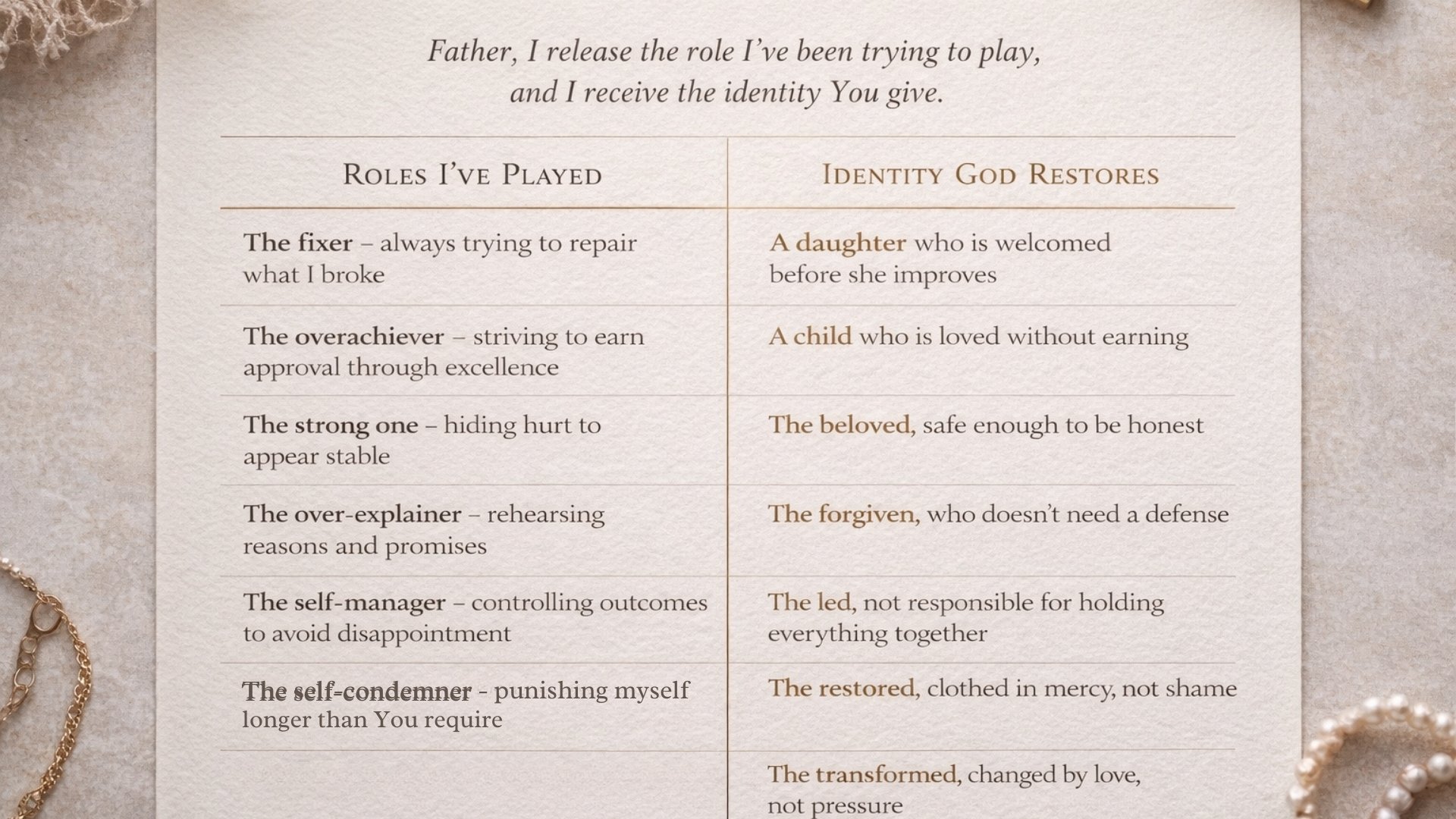
Here is an example of how to complete the activity.
Receiving Grace & Mercy
Read Psalm 103:8–12 and Lamentations 3:22–23.
Journal Prompt:
“This is how Your mercy meets me before I change…”
Write about:
Which part of the Father’s response you need most (running, embracing, clothing, restoring)?
How does it feels like to know that you are loved without conditions in this moment?
Transformation from Love
Read Titus 3:4–7 and Romans 12:1–2.
Journal Prompt:
“Because I am loved and restored, I choose to…”
Shift my attitude about…
Surrender my habit of…
Seek your face by…
Final statement: Today, I choose to stop auditioning for a place I already have as I embrace the love, grace, and mercy that God has for me.